This page describes Recalbox 11.0, available only to patrons through the
patronchannel.
A racing wheel plugs in over USB and Recalbox knows it for what it is: nothing to configure, no gamepad to map. In the racing cabinet games it steers over the same travel as the original cabinet, and in a handful of games it gives back the forces the cabinet sent to its motor — the rumble of the verges, the resistance in the corners, the wheel tearing away when you hit the wall.
¶ The wheels Recalbox knows
| Brand | Models | Force feedback |
|---|---|---|
| Logitech | Driving Force, MOMO, Driving Force Pro, Driving Force GT, G25, G27, G29, G923 for PlayStation and PC | ✅ |
| Logitech | G920, G923 for Xbox | ✅ |
| Fanatec | CSL DD, Gran Turismo DD Pro, ClubSport DD, CSL Elite, Podium DD1 and DD2, ClubSport V2 and V2.5, CSR Elite, Porsche 911 | ✅ |
| Thrustmaster | T300RS and its variants, T248; TX, T-GT II and TS-XW experimental | ⚠️ |
| Other brands (Moza…) | Seen as wheels, steering and pedals read | ❌ |
A Fanatec base must be in PC mode: red light, short press on its power button. In PlayStation mode it shows up as a plain gamepad and nothing treats it as a wheel.
What was measured, and what is inferred. The button and pedal layouts come from a G923 for PlayStation, a G920, a G25 (players' reports), a Fanatec Gran Turismo DD Pro base with its CSL pedals and a Thrustmaster T-GT II. The other models of the same family share the same driver and the same button table: they very probably work, but nobody plugged one in here. A wheel from another brand gets the Logitech table: expect misplaced buttons, never a crash.
On the Thrustmaster side (⚠️), the driver does send forces, but no force feedback game has been tried on one of these bases yet: the layouts come from a T-GT II, in its "OTHER" mode. The TS-PC is not recognised as a wheel at all.
¶ Plugging the wheel in
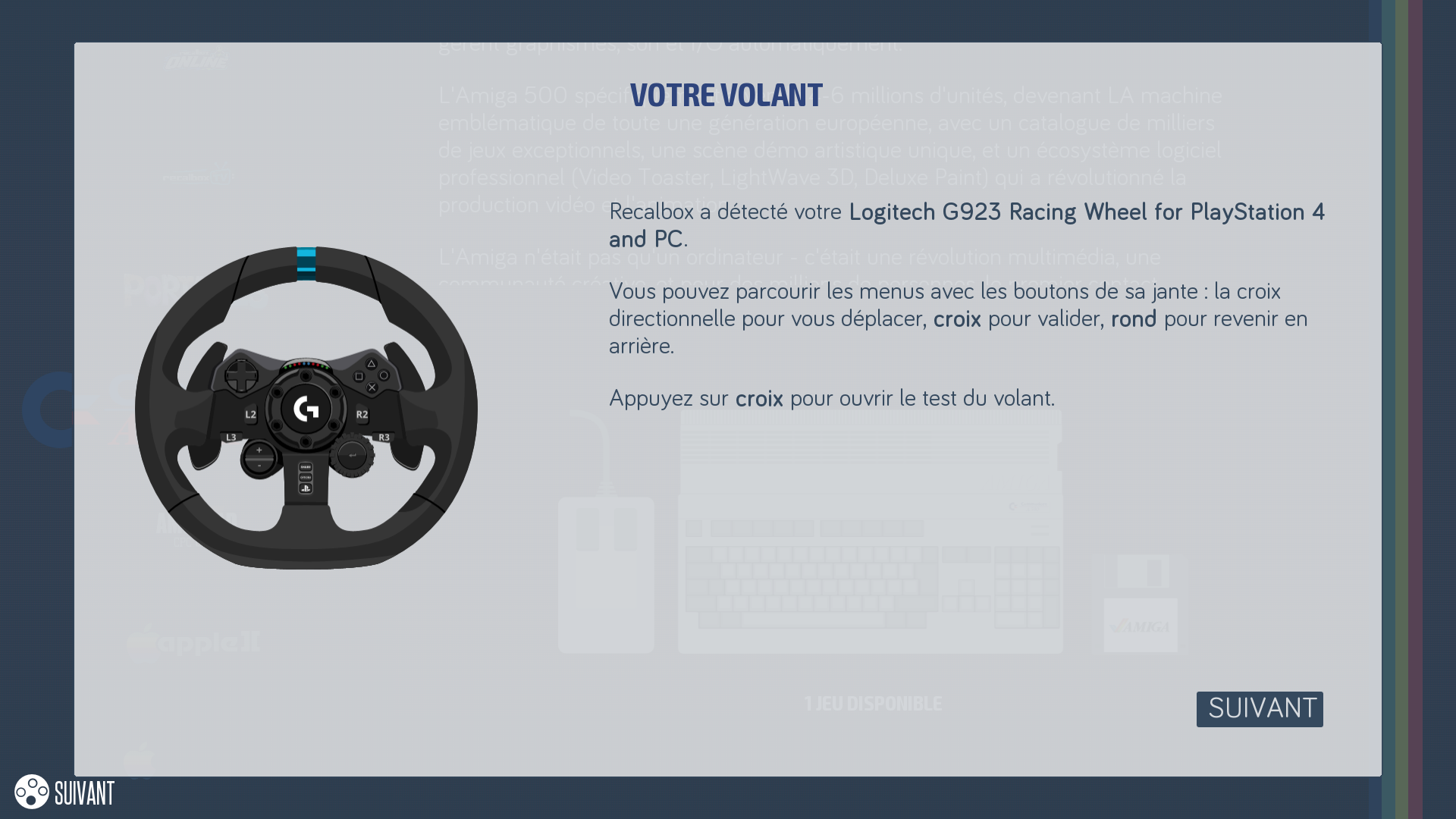
Nothing to do: Recalbox tells a wheel from a rumbling gamepad, writes it a standard mapping, and offers it as a game controller. At the first plug a wizard opens and introduces your wheel over three screens: YOUR RACING WHEEL, then WHEEL TEST, then FORCE FEEDBACK. It does not come back for a wheel it has already seen.
¶ The wheel menu
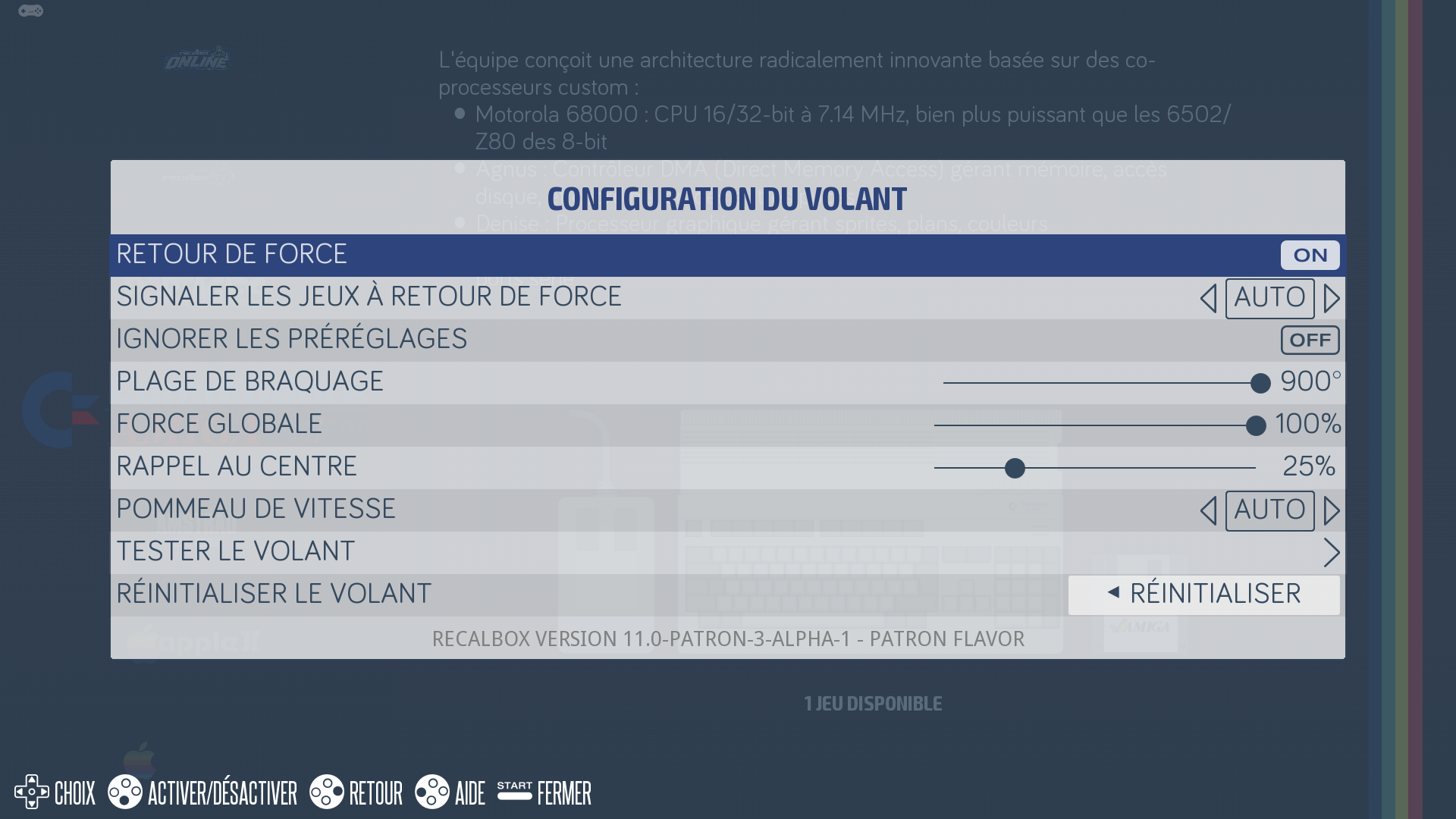
START → CONTROLLER SETTINGS → RACING WHEEL. The entry only shows while a wheel is plugged in.
| Setting | Default | Effect |
|---|---|---|
FORCE FEEDBACK |
On | The forces the emulators send to the wheel. Turn it off to keep the wheel silent. |
MARK THE FORCE FEEDBACK GAMES |
AUTO |
Marks in the lists the games whose emulator pushes real forces. In AUTO the mark only shows while such a wheel is plugged in. |
IGNORE EMULATOR PRESETS |
Off | Uses your steering range everywhere, even on the systems whose original travel is known. |
STEERING RANGE |
the wheel's own | The travel, lock to lock, where nothing better is known. The menu shows your wheel's maximum — 900° on a G923 — and the arcade systems apply their 270° when the game starts. |
OVERALL STRENGTH |
100% | The strength of every force. Lower it if the wheel fights too hard. |
AUTOCENTER |
25% | A spring bringing the wheel back to the centre, useful in the games that drive no force at all. |
H SHIFTER |
AUTO |
The H gate shifter plugged into the wheel. |
TEST THE WHEEL |
— | The test screen (see below). |
RESET WHEEL SETTINGS |
— | Forgets every wheel setting, pedal calibration included. |
¶ Three scopes: global, system, game
The same menu sits in three places, and its title always says what it acts on:
CONTROLLER SETTINGS→RACING WHEEL: for every game;ADVANCED SETTINGS→ADVANCED EMULATOR CONFIGURATION→ a system →RACING WHEEL - <SYSTEM>: for that system;STARTon a game →CONTEXTUAL OPTIONS→EDIT GAME <GAME>→RACING WHEEL - <GAME>: for that game alone.
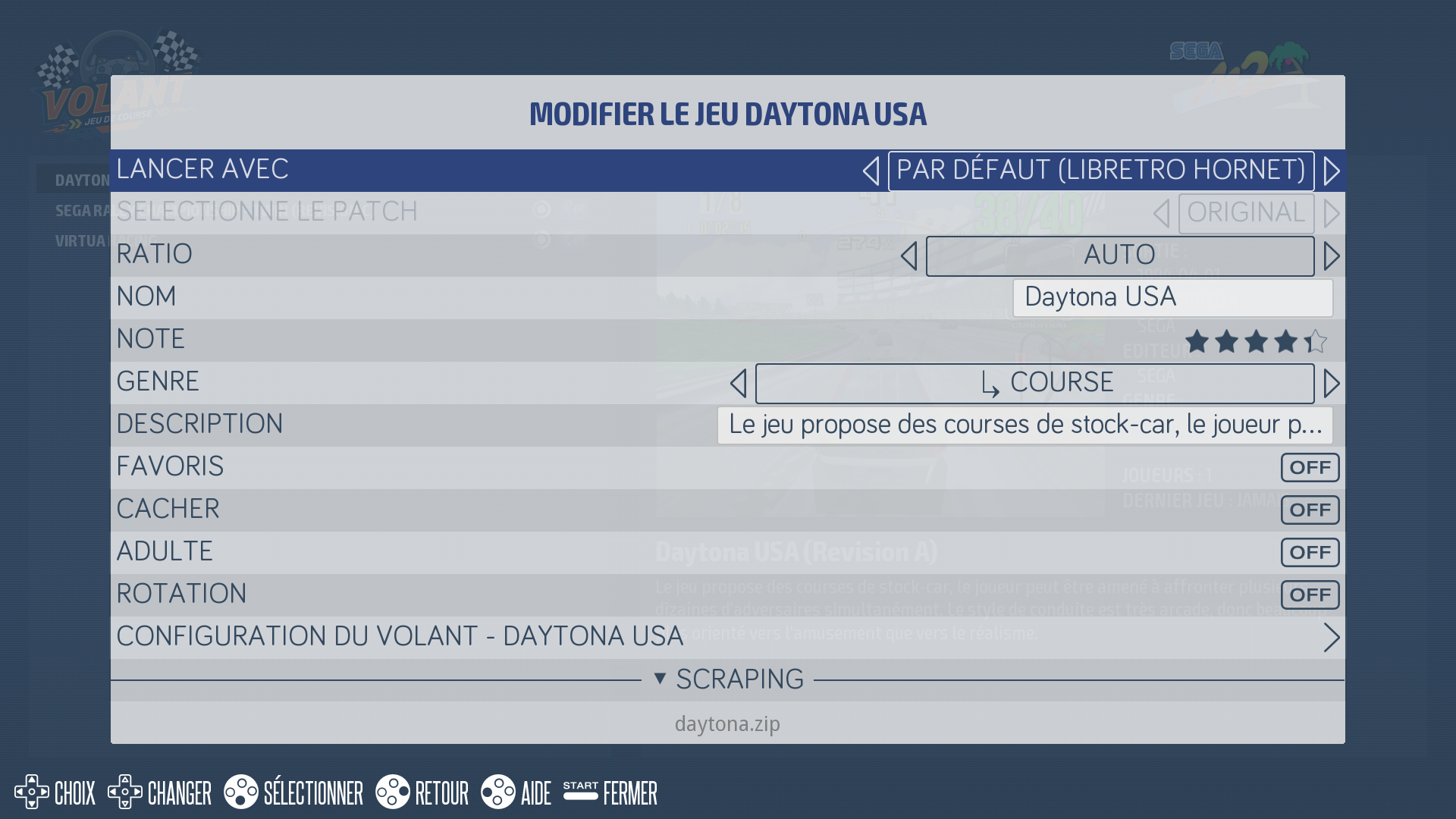
The most precise one wins: the game beats the system, which beats the global setting. Resetting one scope only forgets what that scope defines.
¶ The test screen
RACING WHEEL → TEST THE WHEEL: your wheel is drawn on screen and turns with it, its buttons light up as you press them, and the three pedals — THROTTLE, BRAKE, CLUTCH — show their travel. Enough to check that a wheel is properly seen, without launching a game.
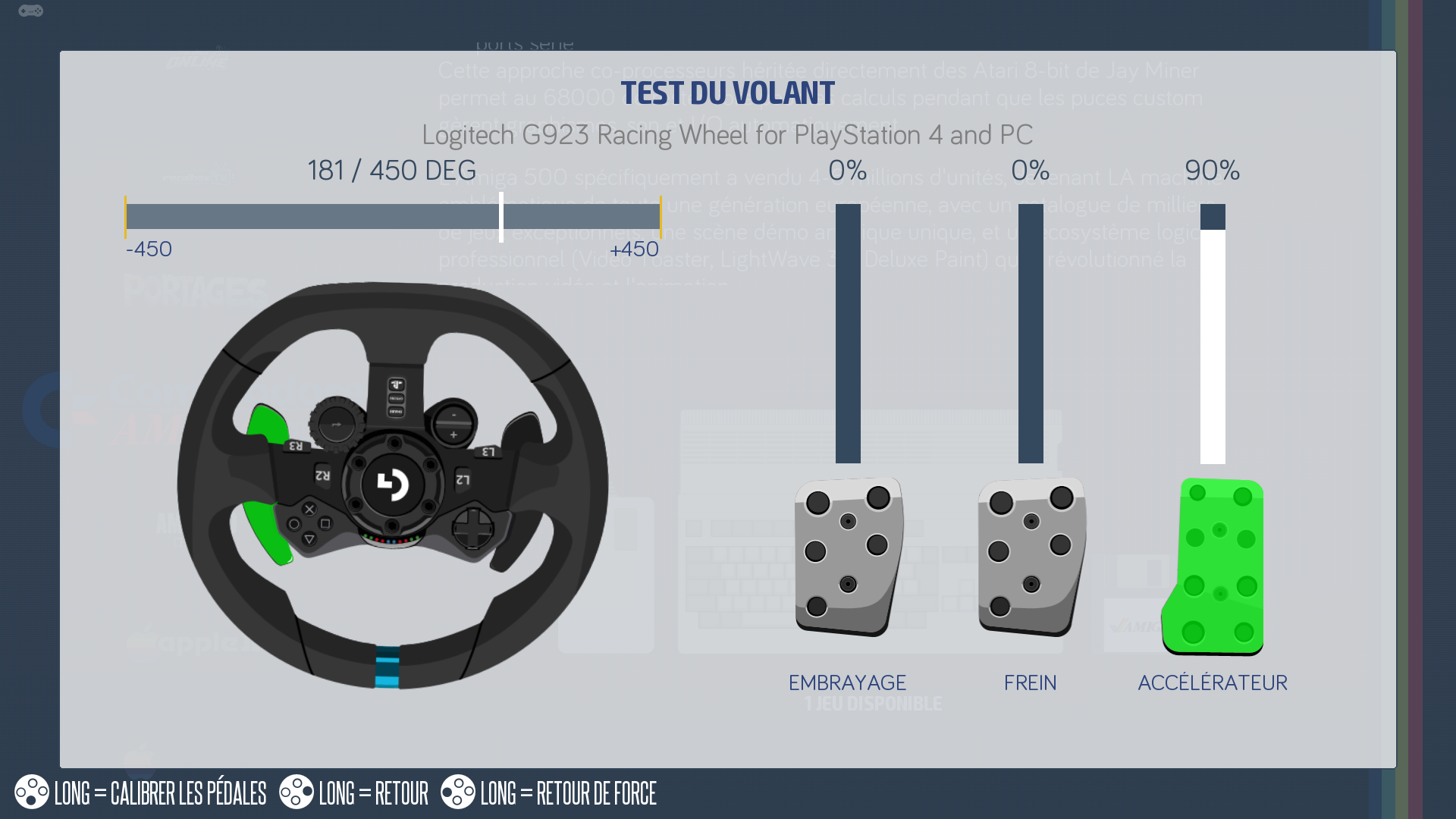
The artwork exists for four wheels: the Fanatec Gran Turismo DD Pro base with its pedals, the Logitech G920, the G923 for Xbox and the G923 for PlayStation — the last one also standing in for the G29 and for other brands.
- A long press on the force feedback button: the wheel plays each effect in turn, so you can feel them.
- A long press on the calibration button: the pedal calibration.
¶ Calibrating the pedals
A stiff brake never reaches the end of its travel: the game then only ever sees part of the braking. The calibration records how far your feet actually go. "Press each pedal all the way down, as hard as you would in a game, then press again to save."
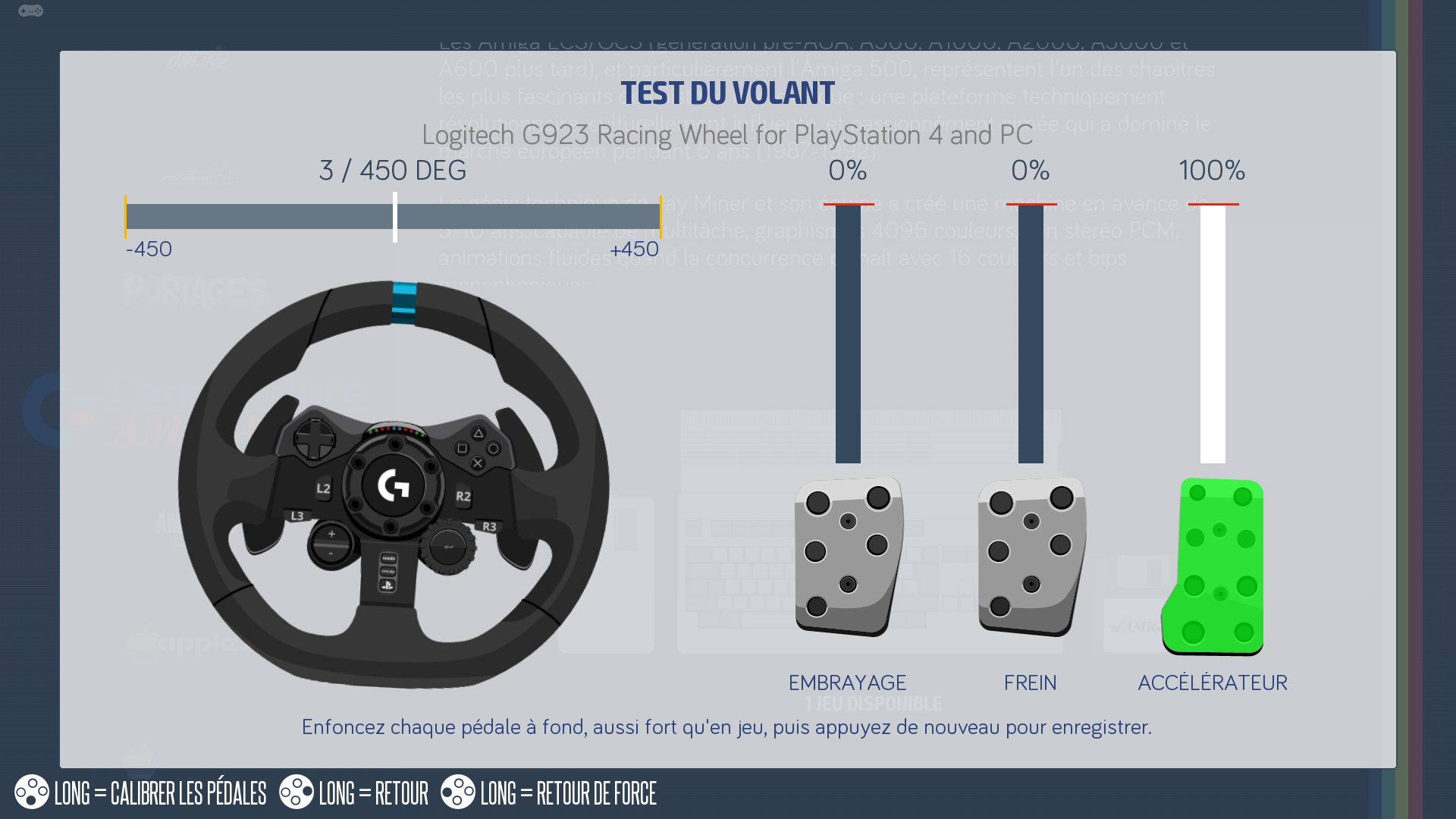
Two things worth knowing:
- the calibration takes effect at the next game launch, not in the running game;
- it belongs to that wheel, known by its USB ids: another wheel keeps its own, and a pedal barely touched during the calibration is ignored rather than badly set.
¶ The steering range
A racing cabinet turns 270° lock to lock, where a G923 does 900 and a Fanatec base up to 2,520. So Recalbox applies 270° to the arcade systems — Model 1, Model 2, Model 3, Naomi, Naomi 2, Naomi GD-ROM, Atomiswave, Namco System 22, Hikaru, MAME and FinalBurn Neo — and elsewhere leaves the wheel its own maximum.
This is not a scaling: the value is written into the wheel, which puts a real stop in, like the cabinet.
The Initial D games are the exception: their cabinet turns three quarters of a turn each way, so 540°, and every one of their sets gets it.
Your own setting always beats those presets for the game or the system concerned. To drop them everywhere at once, turn IGNORE EMULATOR PRESETS on.
¶ The autocenter
Most games drive no force at all, and a wheel left alone stays limp. The autocenter answers that: a spring Recalbox generates by itself, at 25% by default, which resists as soon as the wheel is plugged in.
It steps aside by itself for the cabinets that centre themselves, so that the two springs never add up: the whole Model 3 and Naomi 2 systems, and the games Ferrari F355 Challenge, Maximum Speed, Faster Than Speed, Ace Driver, Victory Lap and Rave Racer.
¶ Which games push real forces
A cabinet game sent orders to its wheel's motor. Those orders exist in emulation: here is where they reach your wheel.
| System | Emulator | Games |
|---|---|---|
| Sega Model 1 | blueflash |
Virtua Racing |
| Sega Model 2 | hornet |
Daytona USA, Sega Rally, Indy 500 |
| Sega Model 3 | Supermodel | Daytona USA 2, Scud Race, Sega Rally 2, Dirt Devils, Le Mans 24, Emergency Call Ambulance |
| Naomi | flycast-next |
18 Wheeler, Ferrari F355 Challenge (Twin versions included), Tokyo Bus Guide |
| Naomi 2 | flycast-next |
Club Kart, The King of Route 66, Initial D Arcade Stage 1 to 3, Sega Driving Simulator |
| Atomiswave | flycast-next |
Maximum Speed, Faster Than Speed |
| Namco System 22 | sys22 |
Ace Driver, Victory Lap, Rave Racer |
| MAME | mame_latest, mame_old |
San Francisco Rush, SF Rush: The Rock, San Francisco Rush 2049 |
Nothing to turn on: MARK THE FORCE FEEDBACK GAMES sits on AUTO, and the mark shows up in the lists as soon as a force feedback wheel is plugged in. The force feedback sort gathers them.

The other racing games play perfectly well with a wheel: they steer, accelerate and brake, with the autocenter as their only resistance. Either their cabinet had no motor, or the emulator does not reproduce it — FinalBurn Neo sends no force at all, whatever the game.
On the Model 3, Supermodel has its own sliders — constant force, self centering, friction, threshold — under ADVANCED EMULATOR CONFIGURATION → SEGA MODEL 3, while a wheel is plugged in.
¶ The H shifter
An H gate shifter is not a device of its own: its gears are buttons of the wheel. Recalbox knows the gate of three wheels:
| Wheel | Shifter |
|---|---|
| Logitech G25 | the one built into the wheel |
| Logitech G923 for PlayStation | a Driving Force Shifter plugged into it |
| Logitech G920 | a Driving Force Shifter plugged into it |
The H SHIFTER setting is AUTO by default: the gears are taken when the wheel says a shifter is plugged in (G923 for PlayStation) or ships with one (G25). The G920 says nothing about its socket: set it to ON to use it.
The games that take their gears from the shifter: Daytona USA 2, Scud Race and Sega Rally 2 on Model 3 (four gears), Daytona USA and Sega Rally on Model 2 (offline), and Ferrari F355 Challenge on Naomi, whose gate has six. In all of them the paddles keep shifting up and down.
¶ The Steering Wheel virtual system
START → SYSTEM-LISTS & GAMELISTS SETTINGS → the VIRTUAL SYSTEMS section → SHOW STEERING WHEEL SYSTEM adds a STEERING WHEEL system to the system list, gathering every arcade game played with a wheel — Out Run, Daytona USA, Pole Position… See Virtual systems.
¶ The wheel takes player one
When a wheel game starts, the plugged wheel becomes player one, wherever it sits in your controller order — it is the one driving, not the pad left on the table. Your saved controller order is untouched: on the other games everyone gets their place back. An online match and a replay playback keep their seats as they are.