This page describes Recalbox 11.0, available only to patrons through the
patronchannel.
11.0 is the biggest update in Recalbox history. Online play has been rethought from scratch, the media centre gives way to Recalbox TV, force feedback wheels arrive, and 46 new systems join the family — fifteen legendary arcade boards among them.
¶ Recalbox Online
Face Recalbox players from all over the world, straight from the frontend, in a dedicated virtual system.
It is all visible from the website too: Recalbox Online and its seven-step walkthrough, the rooms open right now and the cups being played.
-
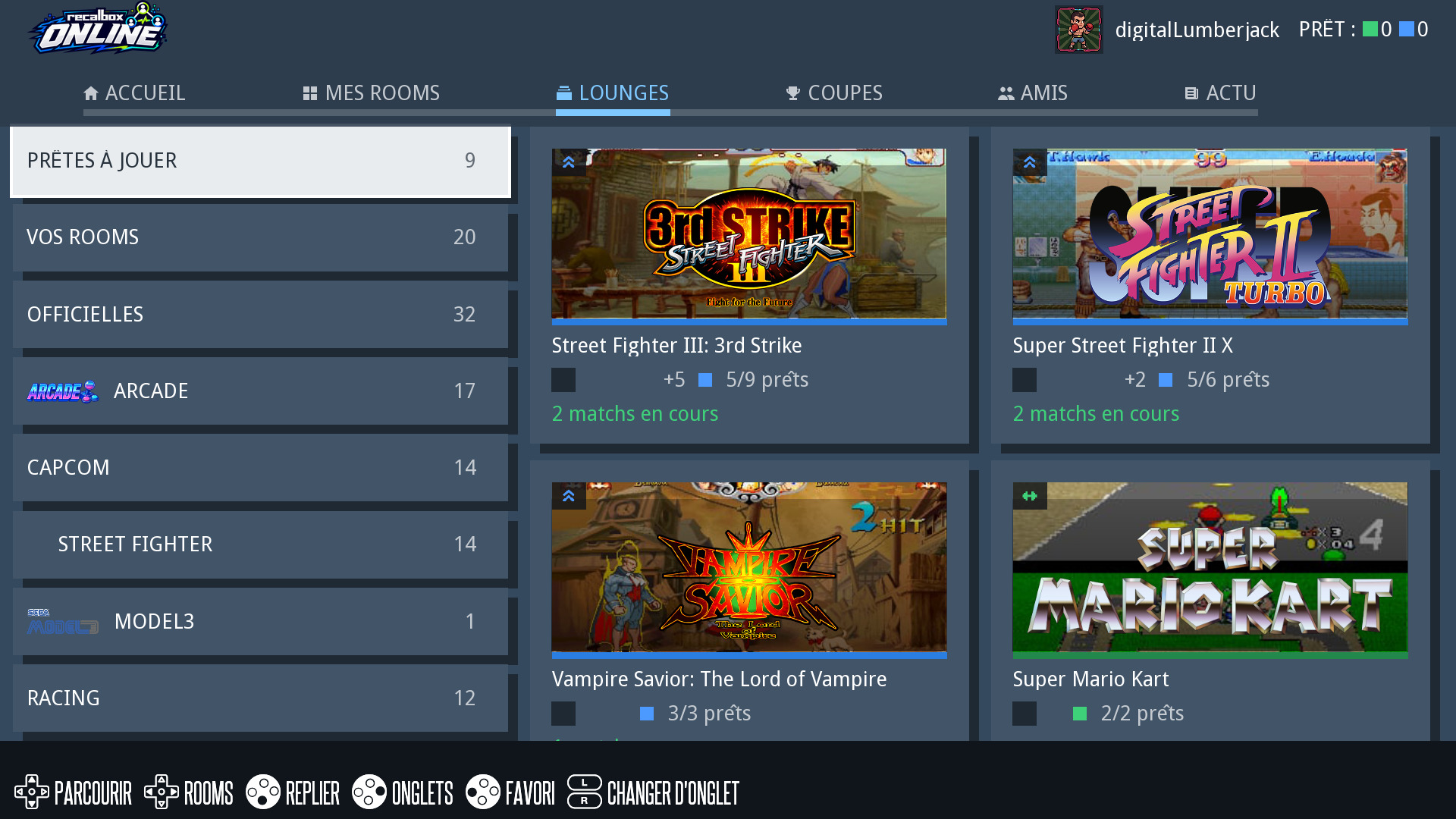
Rooms per game, public or reserved for friends, grouped into themed lounges (arcade, Capcom, SNES…). As soon as two players are ready, the game launches on its own.
-
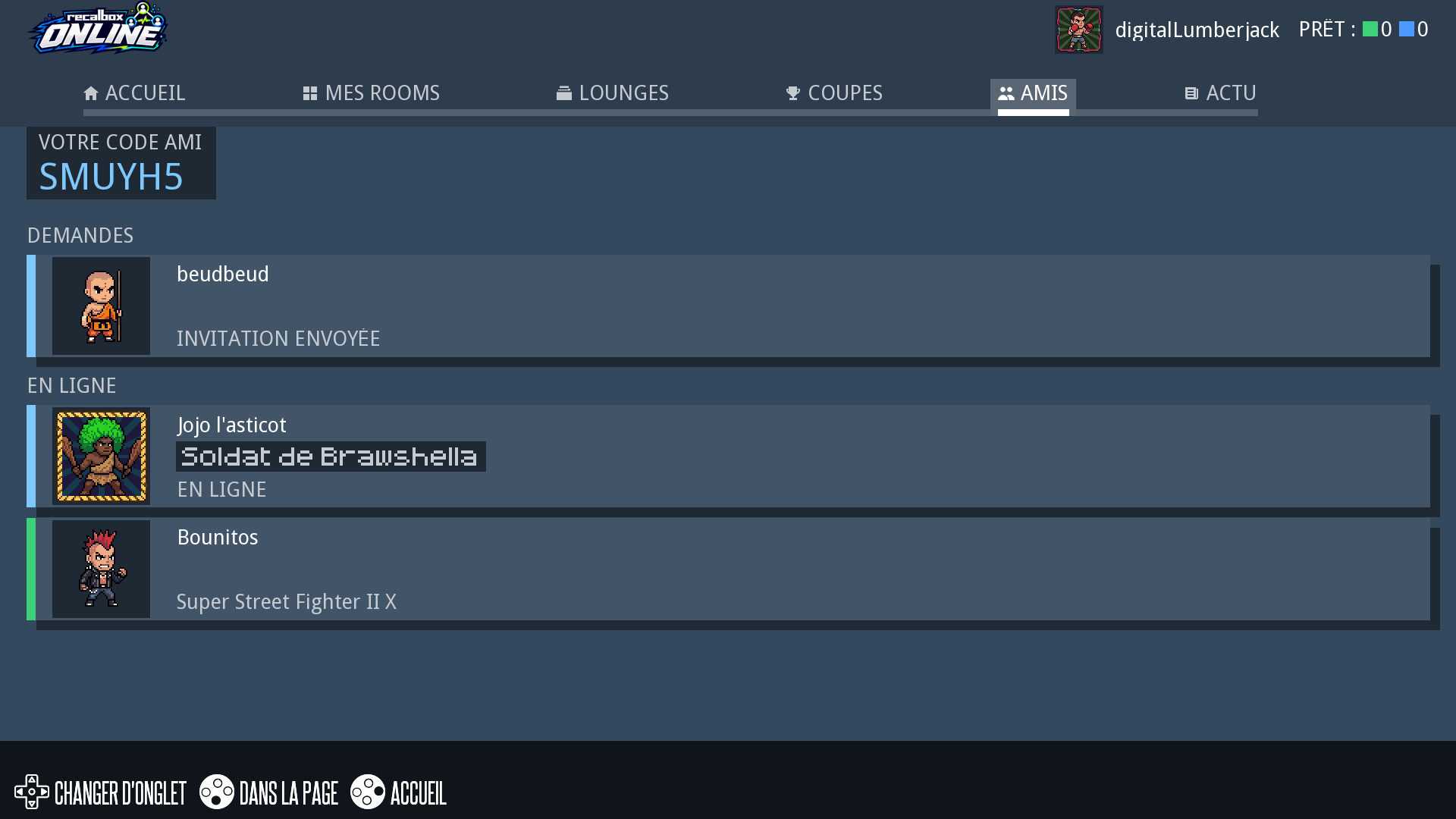
One ID per player, friends and invitations. A match offer reaches you anywhere in the interface, announced by "Here comes a new challenger".
-
Without going through the virtual system: from the game list, pick a game, press the
Recalbox Onlinebutton, invite your friend, and off you go.
-
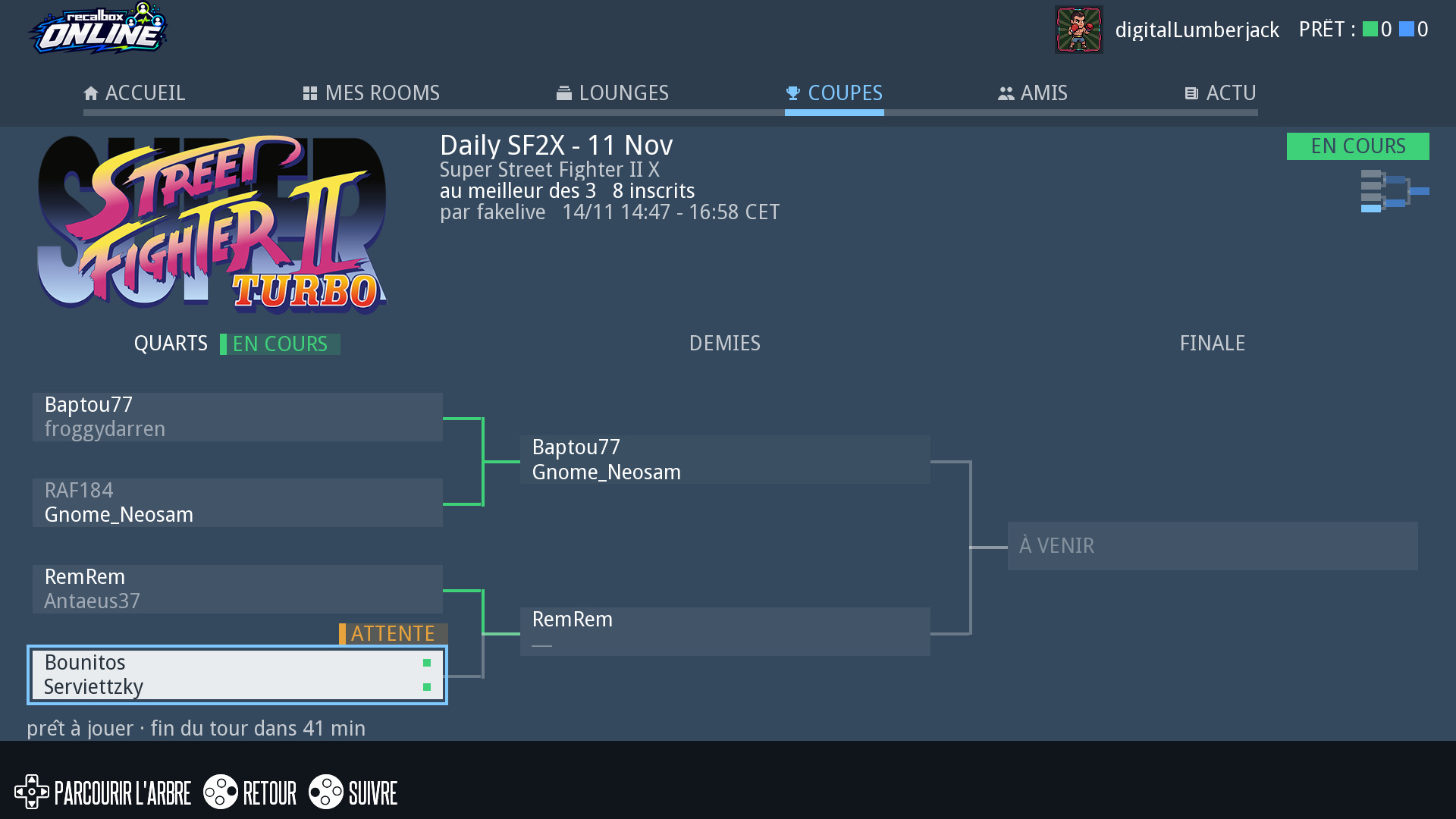
Ranked matches — points per game, a global rank, stars to win — and cups with a bracket and a podium, at a set time or at the time players vote for. The
CUPStab sorts them into bands:MY CUPS,FOLLOWED,CURRENT CUPS,FINISHED CUPS, and a cup's bracket names its rounds —LAST 16,QUARTERS,SEMIS,FINAL. -
Matches are streamed live as video, for as many viewers as want to watch, and cups can be watched again.
-
A profile with titles, avatars and cards, plus a patron area gathering cards, badges, goodies and the jukebox.
-
Linked arcade games, one player per Recalbox and up to eight machines: Virtua Racing, Daytona USA, Sega Rally, Scud Race, Initial D, Club Kart, OutTrigger and Ferrari F355 Challenge Twin.
-
Naomi and Atomiswave versus games — Marvel vs. Capcom 2, Capcom vs. SNK 2… — with rollback to cut input delay.
-
Your network configures itself to keep latency as low as possible, and a logo in the game lists marks the games that play online.
-
A FEED section gathers everything happening on Recalbox Online. Lounges replace the games tab: every game has its official room there, and the game pictures show even on a Recalbox that was never scraped.
-
A match offered during a game shows over the game: the game is paused and set aside, then reloads once the match is over. A versus match opens straight on the character select.
-
MY NETWORKshows a Net Score measuring how reliable your connection is, and explains how to improve it. In ranked, opponents are picked by that score first, and every seat of a room shows its player's. -
A friend's match can be watched from the home page or from their profile, and an optional question asks afterwards how it felt.
-
Raspberry Pi 3 and Pi Zero 2 play online on the same engine as the other Recalbox for some of the optimised arcade games, with no desyncs.
-
Every cup, every challenge and every room has its own page on the website, with its champion and its replays one click away.
-
In a room, a
NOT READY | READYswitch tells the others you are ready: grey while you are not, in the mode's colour once you are. The room's chat shows more lines. -
The
STARTmenu of your rooms and lounges offers to join with a code: the room opens at once, and says so. -
Your profile gathers your statistics and the cups your account has played and won. With a RetroAchievements account set up, one more tab there shows your points, your achievements and your progress game by game.
¶ Recalbox TV
The new media centre replaces Kodi. It is built for the pad, on HDMI as much as on a CRT.
The Recalbox TV page covers it all: adding a source, naming your files well, the settings.
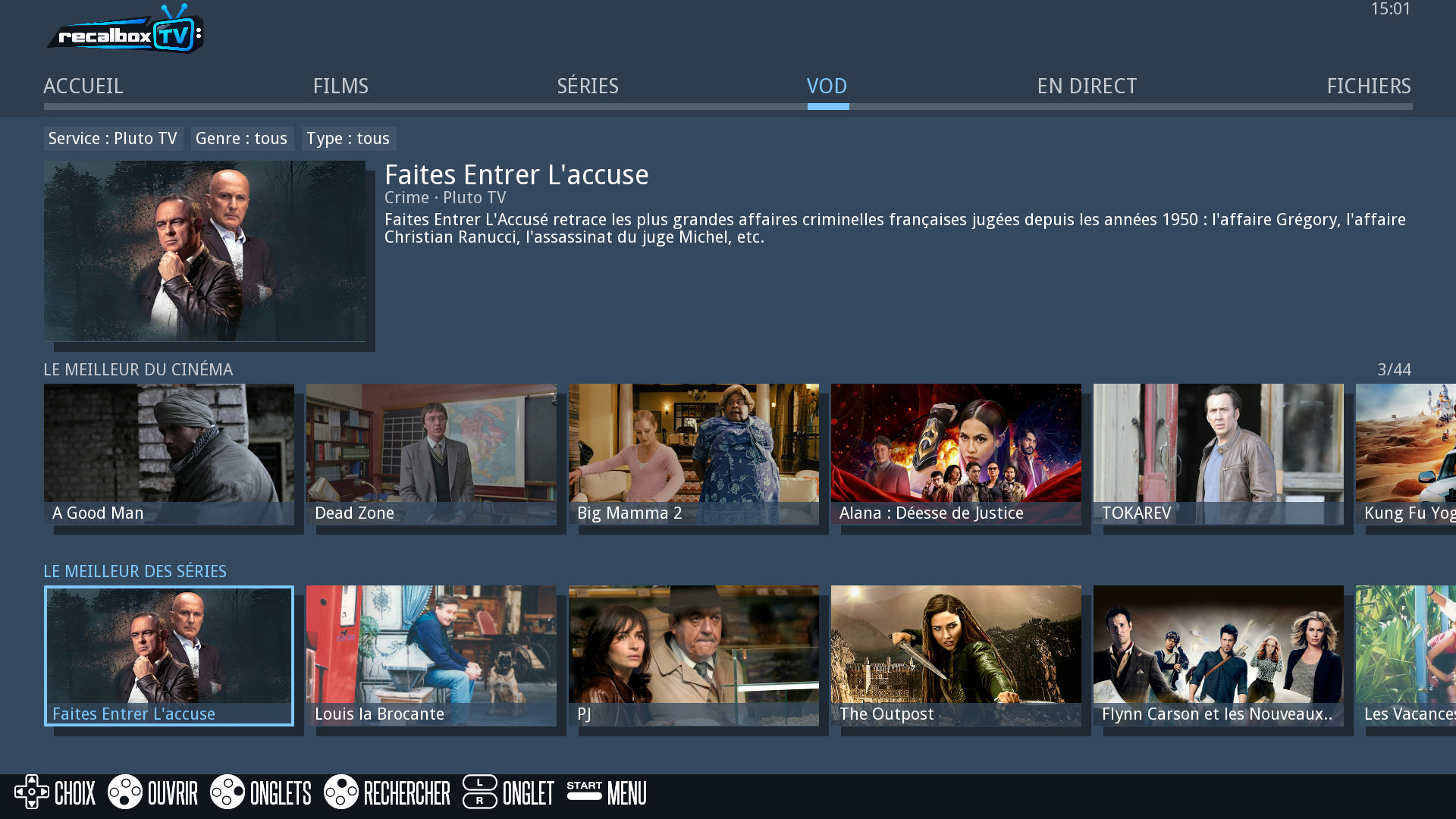
- Sources: network shares detected automatically, a drive plugged into the Recalbox, Plex, Jellyfin and DLNA servers, Pluto TV, Crunchyroll (with an account), IPTV channel lists, a Freebox's live TV with its programme guide, and the Twitch channels you follow — straight away on Raspberry Pi 5, being tried out on Raspberry Pi 4.
- A library that recognises films and series through TMDB and TheTVDB, sorted by genre, decade and source.
- Resume where you stopped, the next episode following on, watched films ticked off.
- A single search from the
STARTmenu, across the library, Pluto TV and Crunchyroll. - Your TV's remote drives Recalbox over the HDMI cable.
- Films keep their own rate, automatically over HDMI. On a CRT, a setting offers a film mode when the screen has one: 24, 48 or 72 Hz — with 48 Hz on an RGB Dual.
¶ Recalbox Challenges
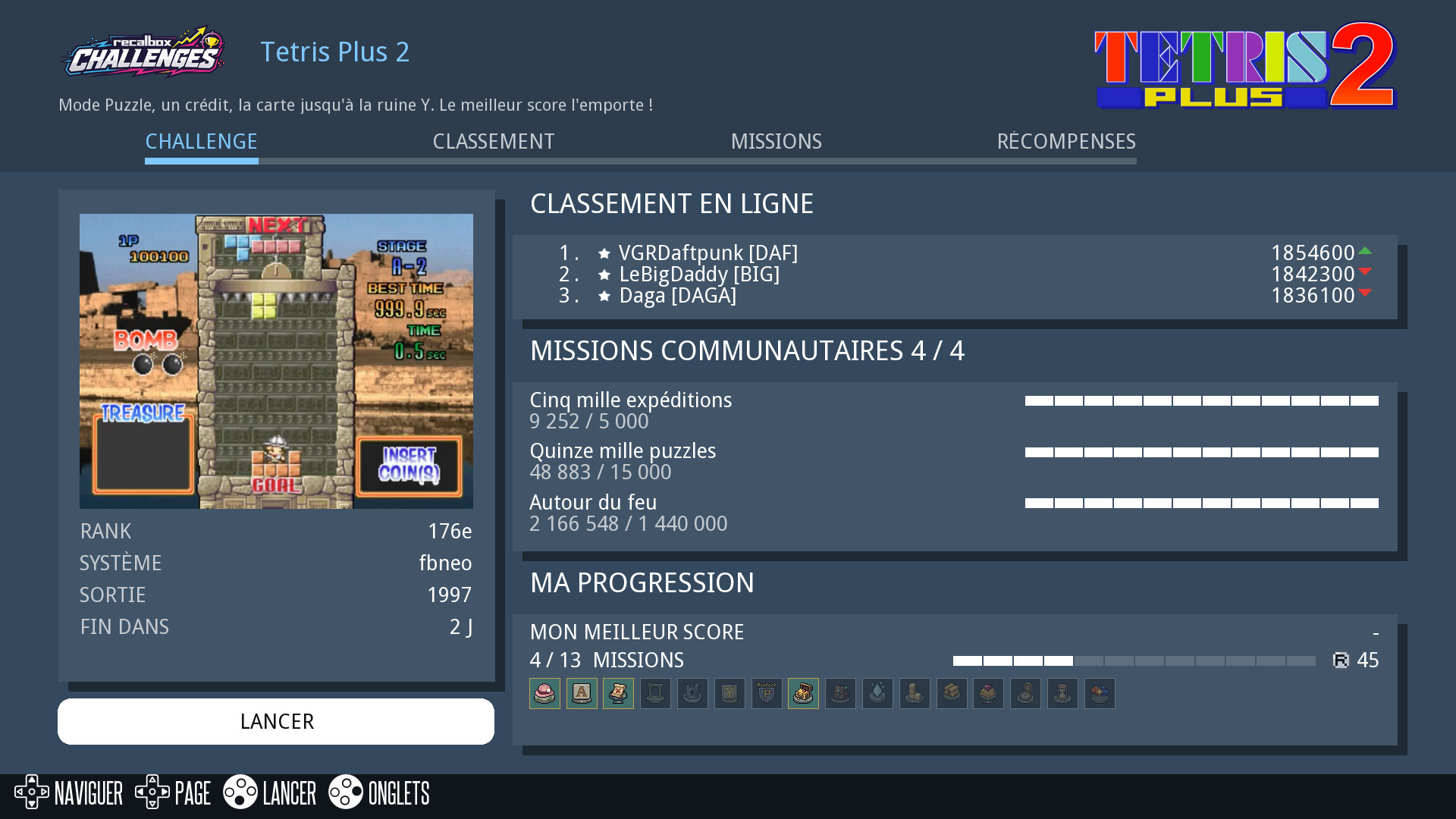
The challenges are public: the fortnight's challenge with its leaderboard, every challenge played so far and the season standings.
- Every mission shows the trophy it earns, and every reward the badge you will actually wear.
- A run cleared without a continue is stamped 1CC.
- Missions appear in your Recalbox's language, and each challenge shows how long is left to play it.
- Every run stays in the history with its replay, and a refused run says why.
- Your friends are highlighted in the leaderboards.
- During a game, the overlay around it shows the score, the place in the leaderboard and the next player to beat — beside the game when it is vertical.
¶ 46 new systems
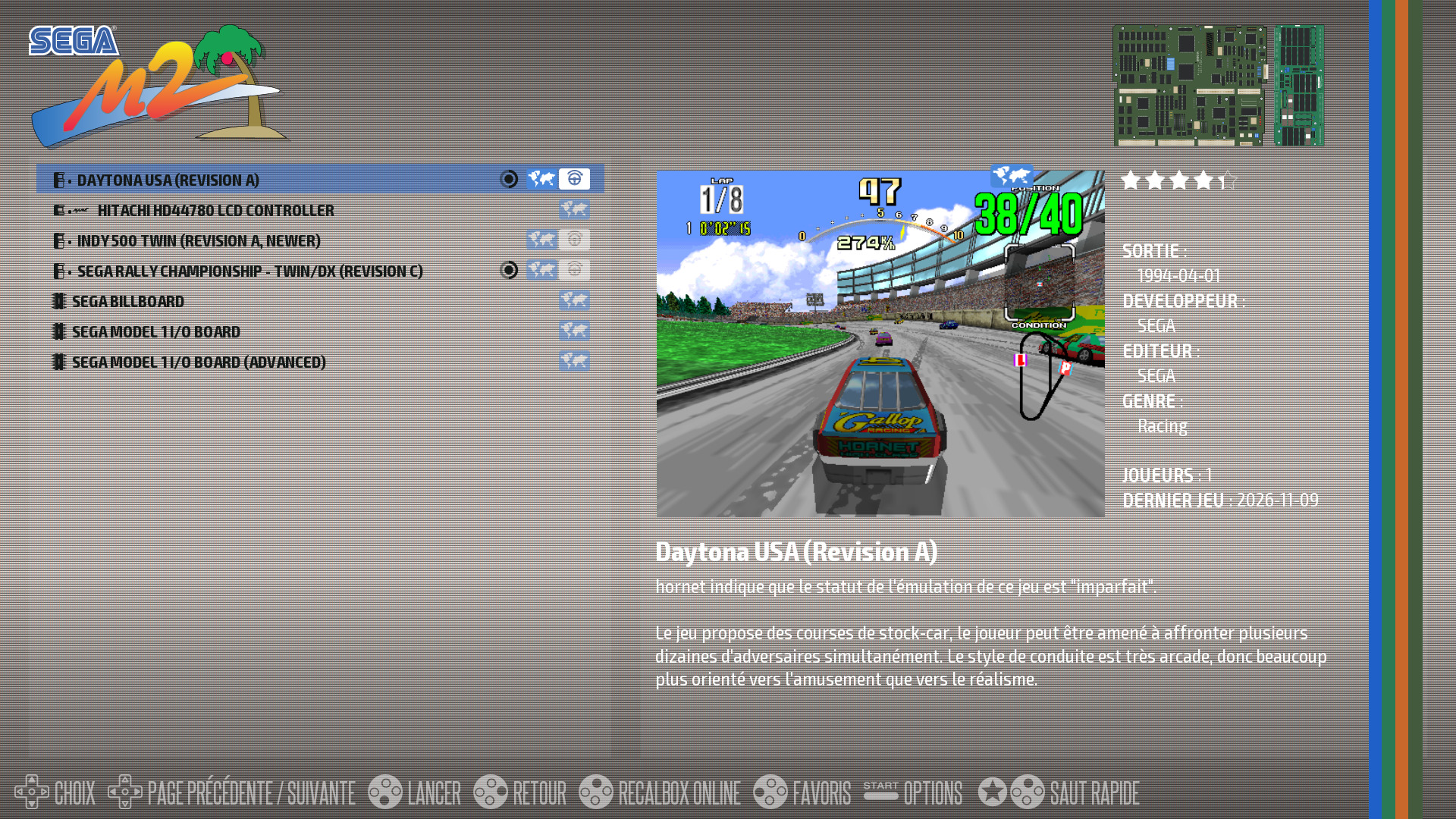
Arcade — Sega Model 1, Sega Model 2, Namco System 10, Namco System 11, Namco System 12, Namco System 22, the Namco System 23, SNK Hyper Neo Geo 64, Aleck 64, the Sega Hikaru, and five PC-based platforms that only a PC can run: Sega Lindbergh, Taito Type X, Taito NESiCAxLive, Sega RingEdge / RingWide and the Namco System ES3.
Consoles and handhelds — Nokia N-Gage, Tiger Game.com, Bit Corp. Gamate, Casio Loopy, Casio PV-1000, Gamepark GP32, VTech V.Smile, Funtech Super A'Can, Atari Jaguar CD, Emerson Arcadia 2001, Interton VC 4000, CreatiVision, MyVision and the PONG AY-3-85XX family.
Computers — Acorn Archimedes, Matra Hachette Alice, APF M-1000 & Imagination Machine, Enterprise 64/128, Fujitsu FM-7, FM Towns, FM Towns Marty, NEC PC-6001, Sharp MZ, Sord M5 and Tomy Pyūta, plus two Microsoft systems: Windows 95/98 and Windows games on PC.
Game engines — Godot Engine (Raspberry Pi 4, Pi 5 and PC), BennuGD and M.U.G.E.N, plus a new port: Jazz Jackrabbit 2.
On top of that, picoarch: a lighter alternative to RetroArch that leaves more power to the emulator, selectable in the LIBRETRO FRONTEND menu.
¶ Arcade and CRT screens
- DUAL OUTPUT: on a Raspberry Pi 5 fitted with a Recalbox RGB Dual 2, an RGB JAMMA or a JVS, the CRT picture also shows on an HDMI screen, in three styles (smoothed, scanlines, sharp pixels). Turn it on with
CLONE SCREEN ON HDMIin the board's menu. - R, G and B levels are set straight from the board's menu.
- RGB JAMMA: every board shares the same input driver, with combos, debounce, per-game remaps and autofire; the board is detected more reliably at boot.
- JVS: racing cabinets get their controls remapped game by game.
- Sega Model 1 and Model 2 display sharp and well framed at 15 kHz.
- On a 31 kHz cabinet, games run at their original rate — up to the 61.7 Hz of a Naomi — instead of being brought back to 60.
- A CRT picture made narrower or wider stays centred; logos and pictograms stay sharp; apostrophes, quotation marks and the letter œ show properly.
- An RGB Dual 2 or RGB JAMMA box plays its sound on the CRT even with an HDMI screen on at start-up, and the coin slot of a Recalbox JVS keeps crediting past the fourteenth coin.
- Model 1 and Model 2 run faster on Raspberry Pi 5, and a controller's stick steers there like a cabinet wheel, Model 3 included.
- ST-V gains accuracy and speed; a long press on
STARTopens the service menu of the ST-V and of the Hyper Neo Geo 64. - The vertical games of the PC cabinets (Taito Type X) are finally shown the right way up, and each player has their own
STARTbutton.
¶ Force feedback wheels
- Force feedback on Logitech G29, G920 and G923, Fanatec CSL DD, Gran Turismo DD Pro, ClubSport DD and CSL Elite (base in PC mode). Experimental: Fanatec ClubSport V2 and V2.5, Podium DD1 and DD2, CSR Elite and Porsche 911. Thrustmaster bases are recognised, forces included, but no force feedback game has been tried on one yet.
- The forces come from the cabinets themselves: Virtua Racing on Model 1; Daytona USA, Sega Rally and Indy 500 on Model 2; Daytona USA 2, Scud Race, Sega Rally 2, Dirt Devils, Le Mans 24 and Emergency Call Ambulance on Model 3; 18 Wheeler, Ferrari F355 Challenge and Tokyo Bus Guide on Naomi; Club Kart, The King of Route 66 and Initial D on Naomi 2; Maximum Speed and Faster Than Speed on Atomiswave; Ace Driver, Victory Lap and Rave Racer on Namco System 22; and the San Francisco Rush games under MAME.
- A test screen draws the plugged wheel — Fanatec GT DD Pro with its pedals, Logitech G920, G923 Xbox and G923 PlayStation — with its buttons and the travel of its pedals, and calibrates them.
- A plugged wheel becomes player one as soon as an arcade racing game starts, and the controller takes its place back on the other games.
- The H shifter of a G25, a G920 or a G923 for PlayStation gives their gears to Daytona USA 2, Scud Race, Sega Rally 2, Daytona USA, Sega Rally and Ferrari F355 Challenge.
- The Sega Hikaru turns like its cabinet, and on the Namco System 22, the wheel, the H shifter and force feedback are supported.
- A Wheels virtual system gathers the arcade games played with a wheel — Out Run, Daytona USA, Pole Position — to be enabled in virtual systems.
- A wheel menu with strength and effects adjustable per system and per game, and a wizard the first time a wheel is plugged in. Everything is detailed on the Racing wheels on Recalbox page.
¶ Lightguns
Gun4IR lightguns are supported — see lightguns in Recalbox.
- A lightgun is checked from
CONTROLLER SETTINGS→TEST A LIGHT GUN, and the test knows the GunCon 2. - The help bar shows the lightgun's buttons, and the Wiimote's when a DolphinBar is plugged in.
¶ Emulators
- Sega Model 3 also runs on the Supermodel libretro core v0.9.1, faster and with fixed 3D, alongside the standalone emulator.
- MAME 0.287 joins 0.278: every game launches with the version it needs. The cores are now called
mame_latestandmame_old, andmame2003is gone — its games move tomame2003-plus. The matching.datfiles are on the Arcade romsets and .dat files page. - New Texas99 (TI-99/4A) and SM510 (Game & Watch) cores.
- Philips CD-i:
same_cdiupdated, runs on Raspberry Pi 5 and handles FMV games. - Virtual Jaguar moves to 3.7.0 and supports the Jaguar CD.
- Naomi, Naomi GD and Atomiswave play over netplay with
flycast-next; Naomi 2 runs on Vulkan on the Pi 5, HDMI included, at full speed. - GameCube and Wii on a CRT: the screen follows the game when it switches between 50 and 60 Hz.
- HatariB loads hard disk images, Visual Pinball handles multi-screen and an external DMD, Solarus moves to 2.1.3.
- Nintendo 64: a new version of parallel_n64, the default emulator on Raspberry Pi 4, Pi 5 and Anbernic RG353, at full speed and with softpatching.
- Nintendo DS: a new DSperate emulator on Raspberry Pi 4 and Pi 5, the default one on Pi 5, with a 3D resolution setting.
- PICO-8: a new Picante8 emulator, the default everywhere. OpenBOR: a new AnyBOR emulator, the default on Raspberry Pi 4, Pi 5, PC, Anbernic RG353 and ODROID GO.
- Updated emulators: PicoDrive, Caprice32, Geolith, DOSBox Pure, Hypseus, Beetle Saturn, Opera and Virtual Jaguar.
¶ PC and Steam Deck
- On dual-boot machines, Recalbox reboots on its own after a gaming session.
- Steam Deck: the built-in pad is mapped properly, screenshots work again, and the picture goes to the TV when it sits on its dock.
- The screen runs at 60 Hz even when the default mode of the TV or monitor is not 60 Hz — 50, 120 or 144 Hz for instance.
- Internal disks are offered again as storage and as share, without the Windows, SteamOS or Android partitions.
¶ Frontend
- Two new tabs: INFORMATION, which gathers everything about your machine on one screen (board, processor, memory, display, sound, network, pads, CRT adapter), and HEALTH, which warns you about disk, temperature, power, clock, network shares or memory trouble.
- "Create a support archive" sends the archive to the team, and a four-character code finds it again.
- The scraper finds the right game even when the filename is wrong, including inside a 7z archive or on a read-only USB stick.
- New logos and overlays for Namco System 22, Hyper Neo Geo 64, Aleck64, Sega Model 2 and Jaguar CD.
- A dot matrix display (DMD), ZeDMD included, over USB or Wi-Fi, shows the selected system and game.
- The frontend can be forced to 4/3 on a wide screen, centred between two black bars; games keep the whole screen.
- The frontend can also be driven with a touch screen or a mouse.
- At the end of an arcade stick's configuration, two kinds of navigation are offered: arcade or console.
- Manual collections keep their order, their games can be moved, and a game's menu has a Collections submenu.
- A setting reset to default applies without restarting, and the console mode of the card reader shows the BIOS screen again.
- The help bar is redrawn: its buttons come from vector pictures, at the size they are shown, it follows the pad you navigate with, and on a keyboard it shows the keys you press.
- The pad OSD draws each pad in the shapes and colours of its own model; the theme options no longer offer a choice of icon set, now pointless.
- The game clips screensaver has a video only variant.
¶ Web manager
The web manager gains a game library with search: a game can be started and quit from it, manuals and maps are shown, and a virtual gamepad with a trackpad lets you play from the browser. Settings apply at once, as in the Recalbox menus, and the monitoring page shows the real hardware, with the measures taken before it opened.
¶ System
- Raspberry Pi 4 and 5: 3D games run faster; on the Pi 4, Sega Rally 2 now reaches full speed.
- Sound no longer vanishes at boot: an output that failed or was unplugged comes back on its own, and every sound card carries its real name.
- A keyboard encoder you set up by hand, such as an X-Arcade panel, is recognised again.
- Console mode has a new BIOS-style boot video.
- Recalbox installed on an internal disk starts without the USB key.
- A setting added by hand at the end of
recalbox.conf— Wi-Fi for instance — is taken into account at startup, and is no longer erased when another setting changes. - Signing in as a patron switches scraping to the Recalbox servers; the choice made afterwards is kept.
- ODROID GO: the boot partition is no longer reported almost full after an installation.
¶ Going further
- What's new in Recalbox 10.1 — the previous release
- Update manager — the
stableandpatronchannels - Becoming a patron — what patron access brings, and the tiers on the website
- Supported systems — the public list, updated with every release